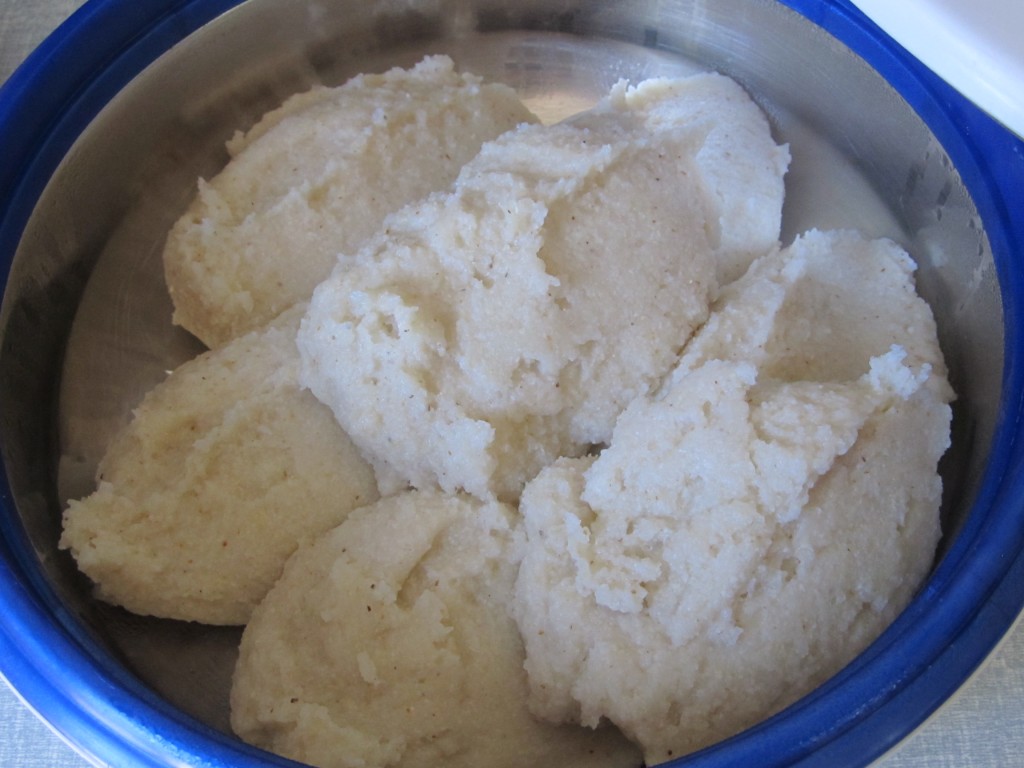
In the past week I've spent time teaching at Mercy and working at Chikumbuso. I cannot even begin to tell you how much I love this place, and the people. I have so much to learn about Zambia, and everyone here is so kind and gracious! I wish you could meet all of these people. During one of the lunch breaks at Mercy, I sat with with a co-teacher friend of mine and we simply talked for hours and ate (quite possibly the largest plate of rice I've ever encountered; they feed the students well!). And Beauty, one of the widows at Chikumbuso, invited me to her house as she told me her life story. A widowed friend of mine and I prayed that she would feel less ill, and a few of us laughed about my first nshima meal. Serah, a student in my sixth grade class, gave me a lovely drawing she made in our craft class...pretty much in spite of me, I'm horrible at art and can only sort of handle stick people!...and wrote along the bottom "I love you so much." Tiny snippets don't do them justice, but I hope you can get to know and love these people at least a little bit!
I've spent some time trying to truly think and understand the profound hopelessness found in a lot of these slums; it is a victory to make it past five as a child, and kids literally grow up without dreams because they don't anticipate living long enough to grow into any aspirations. They have seen siblings and parents die, and I really don't know how to grasp what it's like to believe you won't survive to the age in which most dreams can be realized. And the fact that these are real human beings, not categories or statistics or just pictures, is a problem for me. Today at Chikumbuso the teacher asked all the students of the class to introduce themselves and say what they would like to be when they grow up. I'm not kidding when I say I almost cried with excitement seeing these children who live in the slum and who were receiving the gift of education, food, and healthcare, stand up and say they want to be pilots or nurses or teachers or pastors, to hear them giggle when others spoke, and to see their joy about completing their education. These kids have hope. I still really, really don't understand why there is a lot of difficulty in life. But I do understand a little better why God says these three remain: faith, hope, and love. And why He says the greatest of these is love. (See verse 13). Without these three, life collapses. With them, life can be possible, even beautiful.
I would love to just sit here and write, after spending time here, that I'm utterly remade and compassionate and "good" (I mean, that'd be a nice thing to be) and that I will forever love well and love completely--with the kind of love that actually gets you off your butt and your mind off yourself--and that now I know how to live simply so others can, well, simply live. But it isn't true. The real truth is that I'm a huge hypocrite-in-process. I care about these people, but I spend a lot of time thinking about the way I look. I want to help them, but I'm also really lazy and the thought of actually being able to do something makes me just tired sometimes. I love being in Zambia, but I find myself thinking of ways to fit service into a more comfortable, easy lifestyle and crafting eloquent justifications for selfish behavior. And mostly, it's really scary to think of caring about real human beings, instead of simply causes from which I can justify walking away. Because if I actually try, actually meet, actually see, I'm vulnerable and responsible. I remember sitting in my dorm room in winter at Northwestern feeling so frustrated and upset and angry because the homeless shelters close by were overflowing. I knew my homeless friend Jeff would be sleeping outside in the wet snow. Jeff is a real person I love, poorly at times, and he's not a cause or a group. He's somebody that I know! And I know these people now, Beauty and David and Ruthie and Agness and Edna, but I still find that I'm pretty stuck on myself. So I'm a hypocrite-in-process. Donald Miller in his book A Million Miles in a Thousand Years said "when we live [our story], we are telling the people around us what we think is important." I'm really trying to figure out how to re-mold what I think is important, and how to actually live it.
You may not see many pictures of people or children on this blog, at least not for a while! I hope to be very, very careful about maintaining the dignity of the people here, and I never want them to feel on display or an object for pity or minimization and marginalization. In fact, my hope in serving in Zambia is to do the exact opposite: to care for these people and show them that they are valued and loved...even though I know I'll make lots of huge mistakes. Picture-taking can be done in an appropriate fashion, and I hope the opportunity will arise for me to share these people I love with you in snapshots, because I'd love for you to meet them "face-to-face!" But that's not the end goal, so please forgive the lack of pictures for the time being. Here is just one snapshot of a time when the widows and I were celebrating the delivery of a soy bean donation. It was a very fun time for all of us!
Thank you so much for reading!
“Miracles are a retelling in small letters of the very same story which is written across the whole world in letters too large for some of us to see.” ― C.S. Lewis
Thursday, July 18, 2013
Sunday, July 14, 2013
Baby elephants
Hopefully later I will be able to share a few stories, but for now please enjoy some pictures!
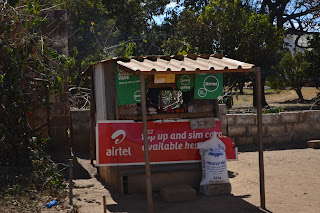
These roadside stands are everywhere in Zambia; this one is very nice. The white bag in front contains mealie-meal, which is used to make nshima.
Fresh avocados are unlike anything found in a supermarket!
We met these rescued elephants at an orphanage just south of Lusaka. Poaching is still a very serious problem here--just a few days ago, over 80 elephants were killed by poachers--so many baby elephants are left without parents. One of these little (um, comparatively little) guys was rescued after falling into a swimming pool!
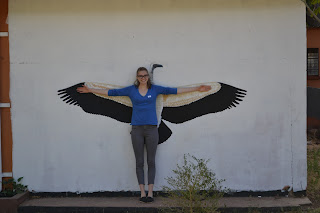
I'm a little bit tall. Also these birds are ginormous.
They live here.
I made friends with a zebra...
...and an ostrich.
This is beautiful David, a child of one of the widows at Chikumbuso. He was making silly faces at the camera, and when he looked at the pictures, he'd crinkle his nose and laugh so much he stuck out his tongue. When you wave at him he just erupts into a smile, and he loves dancing along with music!
Thank you so much for visiting! I hope you'll come back soon for stories.
Wednesday, July 10, 2013
Stamped
Stepping off the plane and standing in the customs line last night, I was basically jumping up and down inside (well, as much as one can after lots of flying!) at the impending Zambian stamp in my passport and the beginning of my time here. I am so honored and thankful to be in Lusaka!!!
Today, to my absolute excitement, I was able to visit two of the groups with which I hope to serve. The first is the Chikumbuso Widows and Orphans Project in the Ng'ombe "compound" (the Zambian way of explaining a slum) in Lusaka. Chikumbuso is a cheery grouping of classrooms, a beautiful library, and small buildings to accommodate their variety of programs. They seek to empower the most vulnerable: their community center opens the door for 73 widows to work on a micro-enterprise that brings them back to life economically and socially. Today I was able to help some of the widows make some of their incredible creations, and it was such an honor to sit with these women and simply listen. In Zambia, unlike in the US, you can still be called a "youth" until you're around thirty...there is a culture of respect and meaning toward surviving to become elderly, here it is an accomplishment and not something to dread. Chikumbuso's school of over 350 students also incorporates a feeding program, offering lunches of nshima (a starchy, warm, grounded paste made of maize flour called mealie-meal), beans, and a relish made of greens, onions, and tomatoes; many of the children served would otherwise not receive food outside of this basic program. I cannot describe the joy found in waving at a child and seeing their face light up with excitement, and in learning their names and becoming friends! In the tailoring room at Chikumbuso are 30 young adults who have left the streets of the slum to come to learn new life long skills in both tailoring and cooking. Finally, Chikumbuso includes a sponsorship program for grandparents in the community as well as children; for the grandparents, many of whom are the sole caregivers for children orphaned by HIV/AIDS, Chikumbuso supplies mealie-meal, oil, candles, soap, salt and, just recently, firewood to fuel new rocket stoves (more about stoves here: http://www.globalgiving.org/projects/fuel-efficient-stoves-for-23-grandmothers/). For sponsored children, funds go toward providing a mattress, blanket, mosquito net, washing basin, toothbrush, toothpaste, umbrella, a new pair of school shoes, a health card that provides a years worth of services at the local clinic soap, mealie-meal, oil, sugar and beans, as well as the finances to pay school fees for continuing education (i.e. going past 6th grade). This sponsorship also makes it possible for children to attend the school at Chikumbuso without penny of fees. Across the board, from sponsorship of grandparents and children to orphans who stop by for a meal, Chikumbuso operates in a manner of respect for all people with the goal of increasing their well-being and self-sufficiency.
Mercy Ministries, the second organization I visited, is Zambian-run and receives a great deal less attention and US assistance than Chikumbuso. The classrooms are small and made of natural materials, the library contains books in vernacular, and so many children want to attend that they split the day into shifts of students. Their focus is a lot smaller, no sewing rooms or micro-enterprise stores, but I definitely felt at home at Mercy. The program manager Edna introduced me to several classes, and she told the students: "Molly is here to love us, if you have any problems with math she will help you, please pray for her and love her and care for her!" At this the children smiled and laughed and waved with excitement. I was so incredibly humbled and thankful. Something else I love about Mercy is they actively seek to educate and value students with disabilities. In Zambia and in many African countries those with mental or physical handicaps are considered cursed, and the extra care necessary for these individuals, even if others desired to give it, often exceeds families' available resources. These deeply rooted beliefs about spirituality and tradition with regards to health in general inhibits people's perceptions about medicinal treatment, and it often leads to abuse of the ill or neglect of personal illness when "spiritual" remedies do not bring about results. In fact, in native vernacular there is no word for "maintenance," only repair, and this attitude is reflected in the actions of citizens with regards to health. Screenings and preventative medicine are mystifying, and the lack of immediate response to illness because of culture, finances, proximity, availability, quality and a slew of other reasons often leaves preventative illnesses untreated and a great deal of people marginalized. Thus, the care and service of those with special needs at Mercy is truly unique and carries immeasurable value. To learn more about Mercy, stop by their facebook page: https://www.facebook.com/MercyMinistriesZambia. Hopefully I will have more stories to share soon about the amazing love of those in both groups soon. I can't wait to share and celebrate these people with you!
It's all very new and I have so much to learn and to love about this place. Thank you so much for taking the time to stop by and learn how to love Africa alongside me!!
Today, to my absolute excitement, I was able to visit two of the groups with which I hope to serve. The first is the Chikumbuso Widows and Orphans Project in the Ng'ombe "compound" (the Zambian way of explaining a slum) in Lusaka. Chikumbuso is a cheery grouping of classrooms, a beautiful library, and small buildings to accommodate their variety of programs. They seek to empower the most vulnerable: their community center opens the door for 73 widows to work on a micro-enterprise that brings them back to life economically and socially. Today I was able to help some of the widows make some of their incredible creations, and it was such an honor to sit with these women and simply listen. In Zambia, unlike in the US, you can still be called a "youth" until you're around thirty...there is a culture of respect and meaning toward surviving to become elderly, here it is an accomplishment and not something to dread. Chikumbuso's school of over 350 students also incorporates a feeding program, offering lunches of nshima (a starchy, warm, grounded paste made of maize flour called mealie-meal), beans, and a relish made of greens, onions, and tomatoes; many of the children served would otherwise not receive food outside of this basic program. I cannot describe the joy found in waving at a child and seeing their face light up with excitement, and in learning their names and becoming friends! In the tailoring room at Chikumbuso are 30 young adults who have left the streets of the slum to come to learn new life long skills in both tailoring and cooking. Finally, Chikumbuso includes a sponsorship program for grandparents in the community as well as children; for the grandparents, many of whom are the sole caregivers for children orphaned by HIV/AIDS, Chikumbuso supplies mealie-meal, oil, candles, soap, salt and, just recently, firewood to fuel new rocket stoves (more about stoves here: http://www.globalgiving.org/projects/fuel-efficient-stoves-for-23-grandmothers/). For sponsored children, funds go toward providing a mattress, blanket, mosquito net, washing basin, toothbrush, toothpaste, umbrella, a new pair of school shoes, a health card that provides a years worth of services at the local clinic soap, mealie-meal, oil, sugar and beans, as well as the finances to pay school fees for continuing education (i.e. going past 6th grade). This sponsorship also makes it possible for children to attend the school at Chikumbuso without penny of fees. Across the board, from sponsorship of grandparents and children to orphans who stop by for a meal, Chikumbuso operates in a manner of respect for all people with the goal of increasing their well-being and self-sufficiency.
Mercy Ministries, the second organization I visited, is Zambian-run and receives a great deal less attention and US assistance than Chikumbuso. The classrooms are small and made of natural materials, the library contains books in vernacular, and so many children want to attend that they split the day into shifts of students. Their focus is a lot smaller, no sewing rooms or micro-enterprise stores, but I definitely felt at home at Mercy. The program manager Edna introduced me to several classes, and she told the students: "Molly is here to love us, if you have any problems with math she will help you, please pray for her and love her and care for her!" At this the children smiled and laughed and waved with excitement. I was so incredibly humbled and thankful. Something else I love about Mercy is they actively seek to educate and value students with disabilities. In Zambia and in many African countries those with mental or physical handicaps are considered cursed, and the extra care necessary for these individuals, even if others desired to give it, often exceeds families' available resources. These deeply rooted beliefs about spirituality and tradition with regards to health in general inhibits people's perceptions about medicinal treatment, and it often leads to abuse of the ill or neglect of personal illness when "spiritual" remedies do not bring about results. In fact, in native vernacular there is no word for "maintenance," only repair, and this attitude is reflected in the actions of citizens with regards to health. Screenings and preventative medicine are mystifying, and the lack of immediate response to illness because of culture, finances, proximity, availability, quality and a slew of other reasons often leaves preventative illnesses untreated and a great deal of people marginalized. Thus, the care and service of those with special needs at Mercy is truly unique and carries immeasurable value. To learn more about Mercy, stop by their facebook page: https://www.facebook.com/MercyMinistriesZambia. Hopefully I will have more stories to share soon about the amazing love of those in both groups soon. I can't wait to share and celebrate these people with you!
It's all very new and I have so much to learn and to love about this place. Thank you so much for taking the time to stop by and learn how to love Africa alongside me!!
Wednesday, July 3, 2013
Welcome!
Welcome!
Thank you so much for visiting. July 8th I depart for Lusaka, Zambia and I can't wait to love the people there. I hope this blog will allow me to share a little bit of Africa with you. Hope to see you again soon!
Subscribe to:
Posts (Atom)